Underwire Sizing Simplified
Understanding various methods of underwire sizing and a practical guide to finding your underwire size and testing it
For an underwire bra to fit well, having the right underwire is a primary requirement. So, how do you find one? In the previous posts, we discussed various Underwire Styles and how to decide which style to try. But, we haven't yet tackled the root of the matter: Underwire Sizing! How to find your underwire size & test it? So, let's get to it!
Underwire sizing in RTW Industry
Underwire Sizing Methods used by RTW (Ready-to-wear) gets a bad rep and justifiably so as it has lots of flaws. Even so, it does work well for majority of women in a certain size range. So, its logic and assumptions are worth analyzing.
In a nutshell, Underwire Sizing in RTW is : Underwire size is same as Band size for a B cup, and for each cup that you go up, you go up a band size. However, as you go down to A cup or below, wire goes only one size down (from B cup). Table below has a small data set to give you an idea.
| Cup SizeBand Size | AAA | AA | A |
|---|---|---|---|
| 30 | 28 | 28 | 28 |
| 32 | 30 | 30 | 30 |
| 34 | 32 | 32 | 32 |
| 36 | 34 | 34 | 34 |
| Cup SizeBand Size | B | C | D | E | F |
|---|---|---|---|---|---|
| 30 | 30 | 32 | 34 | 36 | 38 |
| 32 | 32 | 34 | 36 | 38 | 40 |
| 34 | 34 | 36 | 38 | 40 | 42 |
| 36 | 36 | 38 | 40 | 42 | 44 |
Now, as you likely already know there is lot of ambiguity in how band size & cup sizes are defined or measured.
For Band size, there are primarily two schools of thought: 1) Band Size = Underbust and 2) Band size = Highbust.
Choosing Band size based on Underbust/ribcage has become more popular now. However, when it comes to underwire selection, I strongly recommend using Band size = Highbust.
Reasons, if you are curious: 1) Most good brands that use Underbust/ribcage, actually add +4. And, since RTW assumes highbust is always underbust + 4, its kinda same. 2) Wire is widest at highbust, not underbust. 3) Too large wires is one of the biggest issues with industry sizing and that problem magnifies on using Underbust as bandsize.
For a small range: cup size B to cup size D, RTW kinda works pretty decent especially when it comes to wire sizing (but not bra/cup sizing). Above cup size D, while most RTW keeps increasing wire sizes with each cup size, there just isn't enough room at the center front to accomodate a larger wire. (Something we discussed in the post about Vertical wires) So, for any given band size, the wire size for cup D can be considered the upper bound for the base wire size (in Universal wires).
Essentially, if your highbust is X (rounded up to the nearest even number), most likely X + 4 is the largest Universal wire that will comfortably fit on your torso - that is without wires overlapping or causing east west issues. If you were to overlap wires or ignore a lit bit of east-west issues, you can go up to wire size for cup F (that is X + 8) but at the point center-front gap becomes 0 even as per Industry math.
Note, that when we are looking at this sizes, these are Universal wire sizes. When you take Vertical wires into consideration, the limits change/increase a bit. If you're thinking - not true for everyone, there are exceptions. Yes, absolutely and we'll talk about them shortly but, first lets look at this numbers in a tabular form to get a clear picture.
| Band Size | Universal D | Universal F | Vertical Reco | Vertical Max |
|---|---|---|---|---|
| X | X+4 | X+8 | X+10 | X+12 |
| 30 | 34 | 38 | 40 | 42 |
| 32 | 36 | 40 | 42 | 44 |
| 34 | 38 | 42 | 44 | 46 |
| 36 | 40 | 44 | 46 | 48 |
X = HighBust rounded to nearest even integer
Too large an underwire is the largest cause of ill fitting bras not just in RTW but also in hand-made bras. So, if the wire size you are using is larger than higbust + 4 inches (for Universal wires) or highbust + 10 inches (for Vertical wires), please re-measure, reassess before doing anything else to improve fit.
Also, if you are trying to fit someone else (a friend/client) with a large bust, this flow might come handy as a lower friction starting point:
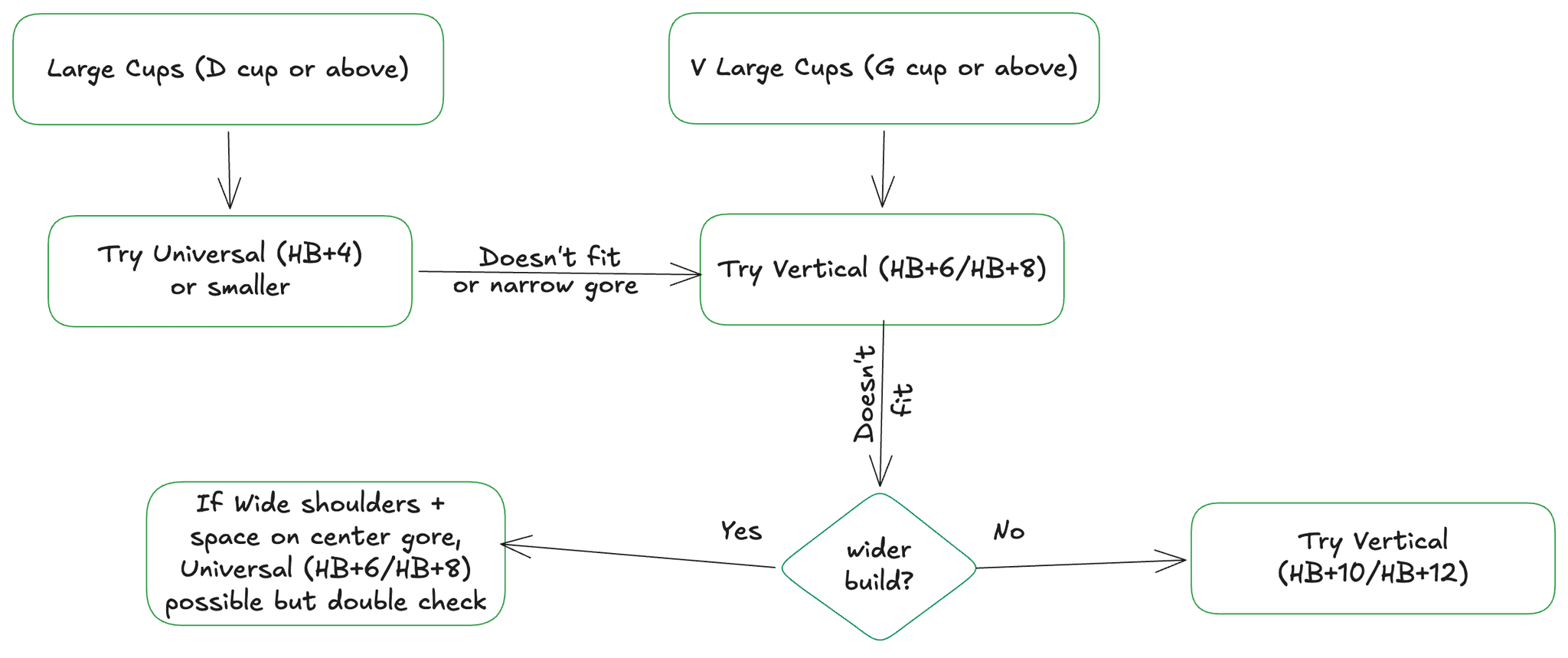
We spoke about larger cup sizes and upper bound to wire sizes based on high bust. What about the lower bound? Does the wire size for cup A form the lower bound? Sadly, no. At the cup size A & below, spacing at center gore actually keeps increasing and if you add to that the fact that the distance between center points of the breast roots on torso do not change with cup size, then wire size should go down. But, industry sizing says no. So, the math here is not mathing. Also, going by real world cases, exceptions (to industry sizing) here are very telling. There was someone with unusually large bandsize but she had almost two inches of center gore spacing. By RTW sizing, she would be AA cup. However, her best fitting wire was HB-4 and using that, her cups were close size D/E! So, yeah for what is smaller cup by industry standards, industry sizing is of no use! So, with that in mind, lets look at better methods of actually measuring your root…
Measuring your breast root
We spoke about issues with industry sizing and how at best it serves as an upper bound for wire sizes. So, how do we actually measure. The simplest way is to measure the width of your breast root. Place two books on both sides of your breast (without a bra ofcourse). If you don't know where the breast tissues ends on your side, just put the book under your arm. Now measure the distance between these two books using a scale. It is easier if you can get a friend to help.
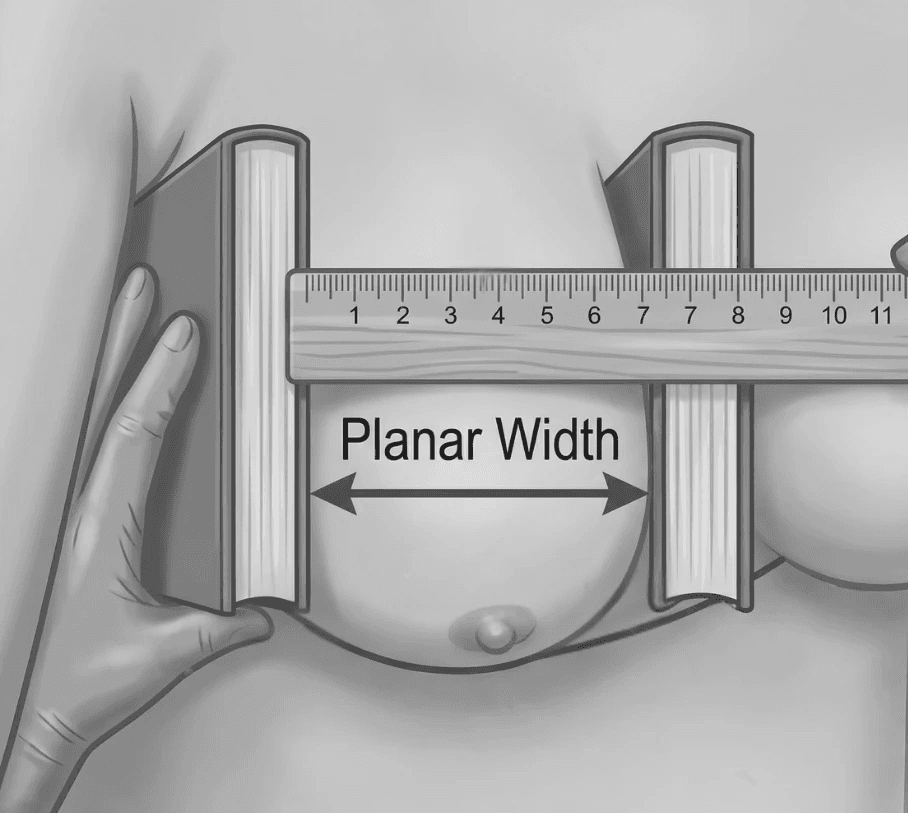
Fig 1. Measuring breast root width using two books and ruler.
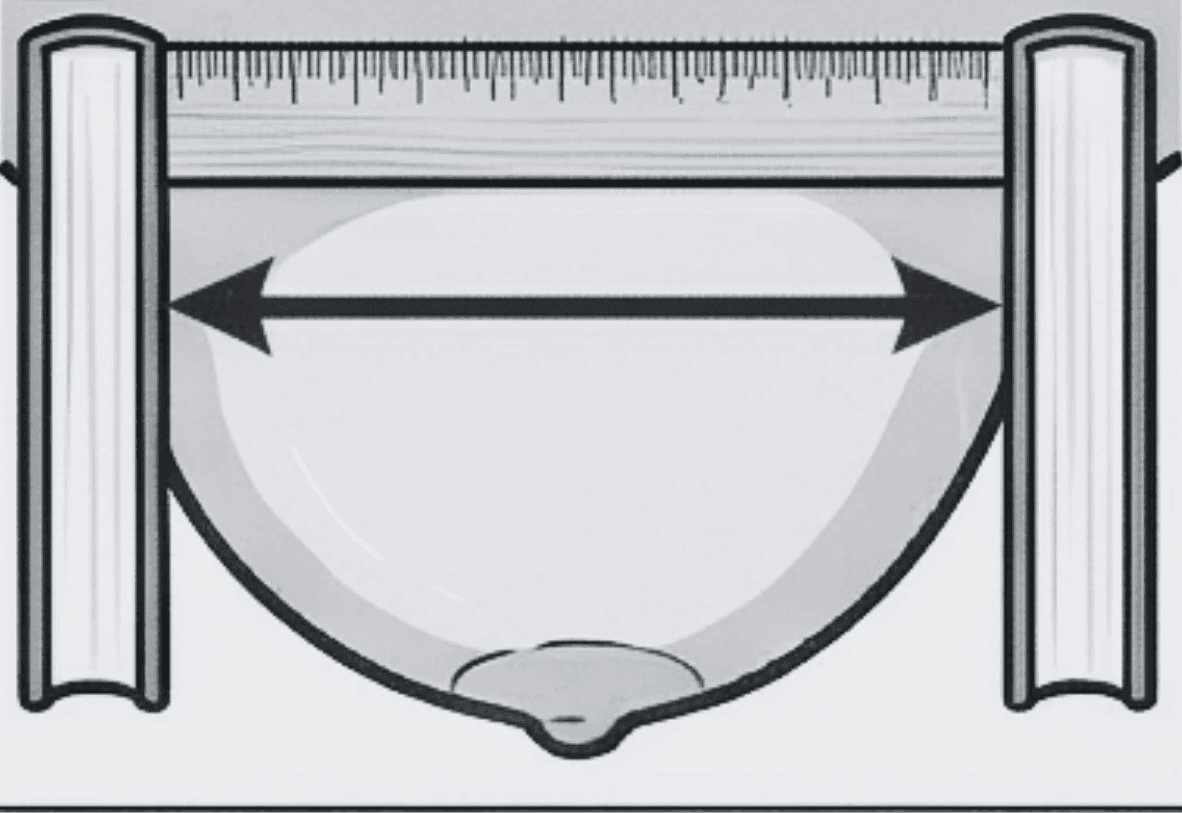
Fig 2. Breast root measurement
Fig 1. shows an illustration of measurement while sitting/standing. However, it is best to do this when bending down 90 degrees - this way you can be sure all breast tissue is between the books.
Compare the root width to the list of wire sizes & diameters and the smallest wire size with a diameter that is larger than your root width is your base size. Chances are this size is going to be a lot smaller than you had imagined. Don't be thrown off by it, treat this as the lower bound for choosing wire size. You can use a wire one or two sizes larger too but preferably don't go larger than that.
One last thing, in the Industry sizing section, we spoke about there could be exceptions for whom size might go beyond the upper limit using RTW sizing. If your breast root width is large or even same width as the upper limit indicated by the industry sizing, you might be an exception else you can comfortably use the upper limit.
Underwire Sizes & Diameters:
It helps to be able to mentally calculate wire size based on width/diameters. So, lets take a minute to understand the underwire sizing math. Underwire diameter goes up by 1 inch every 3 sizes (and that is + 6). And the first whole inch measurement is size 30 which is 4 inch. Below is list of all sizes which are whole numbers (in inches).
| Wire SizeDiameter | 30 | 36 | 42 | 48 | 54 | 60 |
|---|---|---|---|---|---|---|
| Diameter | 4 | 5 | 6 | 7 | 8 | 9 |
If you noticed, (Diameter + 1) x 6 = wire size for all the above whole inch values!
What about the wire sizes in between? Unfortunately, there isn't a neat formula for same but for mental math +1/3, + 2/3 can be used. For eg. size 36 is 5 & size 42 is 6. So, we'd assume size 38 is 5.33 and 40 is 5.66, right? Well, size 38 is 5.25 and size 40 is 5.56. Slightly off, but good enough to get a quick sense of sizes.
The breast root trace
The most recommended method of figuring out wire size in bra making circles is breast root trace. We haven't however spoken about it because I am not a fan. It might work for some people at smaller cup sizes and self-supporting breasts but for everyone else, it will lead to much larger sizes than actual. Without support, breast tissue has a tendency to spill all over, especially under the arms. And, to add to it, if by any chance you are an Omega, then there is zero probability of you being able to pull out the wire (or flexible ruler) without widening it. If you swear by it and prefer to use it, please continue. However make one small change, take the root trace when bending over 90 degrees so that gravity pulls all the breast tissue away from the torso. And, make sure not to move upright before pulling out the wire/flex ruler. Check the size now. Most likely, it is smaller than what you measured earlier.
How to test your underwire size
Now, to the most important part, how to test the wire. You can try putting the bare wire in your root to check. But, like in the case of root trace, breast tissue will spill under wire unless you bend down 90 degrees when you check. Incase, you need to buy the wires and want to make sure before buying, paste the wire chart on a chart paper (or just stick some fusible interfacing on the back side) and now cut out the wire with a little extra paper on the outer side (mini cradle so to speak), bend down and try.
The best test is however is in a well fitting bra. And, changing the wire changes measurements required for the cup. If you go up a wire size, you need to reduce BCD/cup size (for same volume). And, if you go down a wire size, you need to increase BCD/cup size for the cups to have same volume. So, ideally you want to sew different testers for different wires. That said, between two consecutive wires (of same style), you can do a quick pre-test in one bra. Make sure you make the tester for the largest wire but also larger than needed cups (for that wire). Now, wear it and check. Then remove the larger wire and insert smaller wire. Smaller wire will also be shorter so, ensure there is equal amount of space at both ends or push the wire all the way at armhole end. (If its pushed towards centerfront with more space at armhole side, its being rotated wrong way and will cause other issues). Trying a smaller wire might cause the band (meant for larger wire) to feel too tight. Just sew on some extra eyes panel temporarily if needed. When you try the wire, how to tell if the fit issues you are facing are due to small/large wire and not anything else?
Signs the wire you are wearing is too small: The cups are large enough (to have gaping) and yet the wire pokes into the breast tissue.
Signs the wire you are wearing is too large:
- The cups fit right but the wire is sticking away from torso under the arms. (In a well fitting bra, the wire will sorta mould to the torso without you even realizing it. If it is trying to pull away so as to poke into your arm (not underarm) when you put your arms to the side, it is too wide.
- There is empty space in the cup between the wire and the breast tissue at the sides. You can clearly see where the breast tissue ends and the wire is much further. Sometimes this happens at centerfront too but centerfront gaping is not always related to the wire.
- East west issues that just won't fix. Measure bust point to bust point distance wearing the bra. If its unusually large than what is typically the case for you, you have east west issues. And, if rotating the wire and/or tweaking cup measurements doesn't fix this. Most likely the wire is way too large.
This by no means is an exhaustive list but clear signs that your fit issues are wire sizing related.
Summary
And, with this, wrapping up the three part series on underwires!
In the first post, we looked at Universal wires and discussed wire splay. In the second one, we spoke above Vertical wires. And, in this we talked about Underwire sizing. I hope they helped take you atleast one step further in underwire selection. Please let me know your thoughts in comments. Also, is there anything else you'd like me to cover next?
PS: The first underwire pattern Calliope from SassyCut launches next week!!